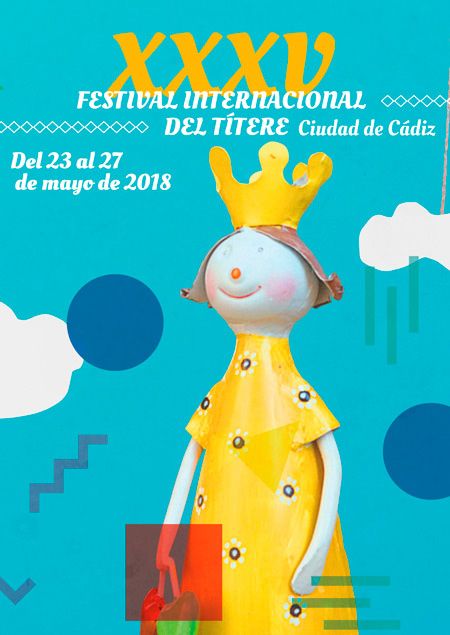
The 35th Cádiz International Puppet Festival is coming to our city, and here at Spanish in Cadiz we’d like to tell you all about it.
Our tradition of puppetry and our passion for the arts in Cádiz are renowned throughout the world. That’s why we can’t miss the chance to tell you a little about this festival, which runs from 23 May until Sunday 27 May. The event will feature 17 companies from across the country, as well as from other countries such as Argentina, Chile, Colombia and Poland, who will put on a total of 34 performances.
As for the participating companies, apart from the Compañía de la Tía Norica (which we’ll tell you more about later)—which, as is tradition, will perform *El sainete* in the only show staged at the Teatro del Títere—other prestigious and award-winning companies are coming to our festival. Examples include Periferia Teatro – presenting Vuela Pluma – which won the Best Show Award at the 2015 Tolosa Titirijai International Puppet Festival; Javier Aranda’s company – with *Vida* – winner of the 2018 Fetén Award for Best Small-Scale Show; and the Títeres Etcétera Company, a finalist for the Max Award and the Lorca Andalusian Theatre Award for Best Show for Children and Families, which is bringing the Teatro Real production *The Brave Little Tailor* for all audiences. Also featured in the programme is the grand opening parade ‘Todos los mundos’, and running in parallel from 23 to 27 May at the Baluarte de la Candelaria is the exhibition ‘Demos un paseo’, showcasing the career of José Alberto Maldonado Ortega, puppeteer with Kaos Teatro, and the micro-theatre show ‘Réquiem’. Most of the events will take place outdoors and will be free of charge at various locations across Cádiz. (Programme)
Our Spanish teachers at Spanish in Cádiz love organising fun cultural activities related to this theme and often arrange visits throughout the year to the International Puppet Museum in Cádiz, where students can learn about the techniques and curiosities of the world of puppetry. They even encourage Spanish students to create short stories which they then perform using real puppets... we can assure you they learn and have a great time.
We also try to introduce our Spanish students to the character of La Tía Norica and her sainete. This company and play is a puppet theatre with a history stretching back over 200 years. Originally from Cádiz, it is a unique example of popular drama inspired by the feelings and way of life of the people of Cádiz. A form of drama centred on two main characters: La Tía Norica, the archetype of the self-taught woman from Cádiz with great natural intelligence, and her grandnephew Batillo, a sort of child hero, a rogue, with whom the women of Cádiz often identify their mischievous children.
This theatre, comparable though older than the Sicilian poppys or the puppets of Liège, and which inspired García Lorca for his puppet theatre, has amassed an extensive repertoire, comprising ‘disparates’ or short farces depicting local customs and Christmas plays, which have partly come down to us thanks to the oral tradition.
The company’s history dates back to 1795, and from then on it performed continuously until 1959, when it partially ceased operations. Throughout that time, the puppets belonged to private owners until 1984, when the Municipal Culture Foundation of Cádiz City Council supported the creation of the current Teatro de la Tía Norica.
As you can see, if you come to study with us at Spanish in Cádiz, you’ll learn not only Spanish, but also a wealth of interesting facts about the culture and society of Cádiz and Spain.
 Back
Back