Learn Spanish at Spanish in Cádiz and experience the carnival!
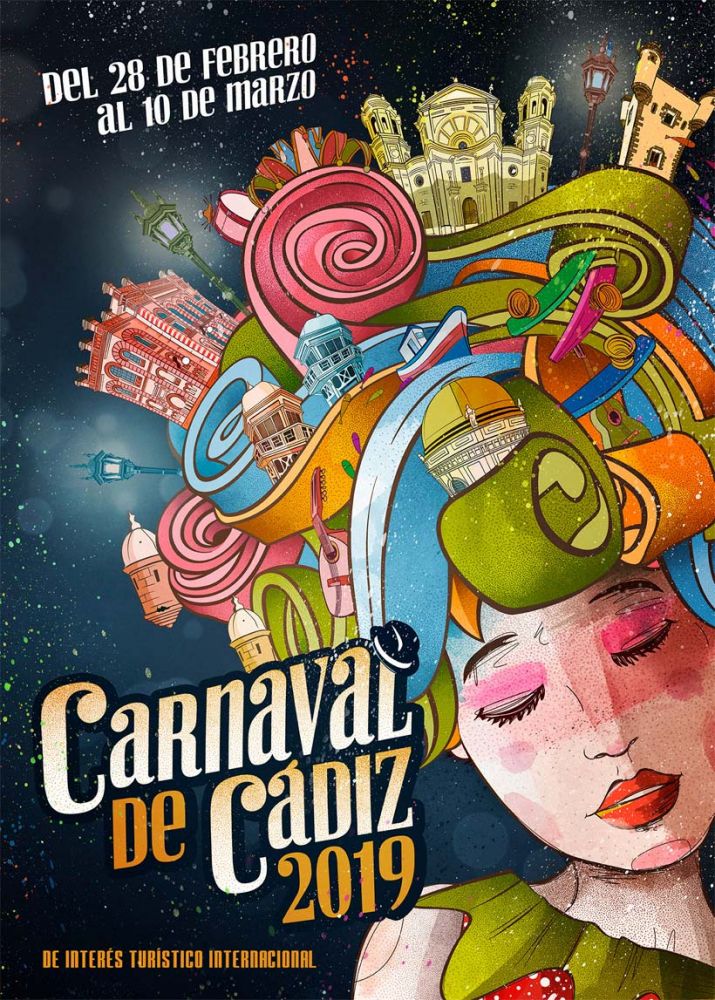
February is just around the corner, bringing with it Carnival. In case you didn’t know, the Carnival in Cádiz, along with the one in the Canary Islands, are the two most important in Spain, yet they are very different. Whilst the Canary Islands’ Carnival is closer to the image we have of Brazilian Carnival, with its parades, costumes and opulence, the one in Cádiz takes place in the streets, on a shoestring budget and with costumes made from old rags.
The festivities kick off with a series of food-themed events: the pestiñá, the erizá, the mejilloná and the ostioná, where people enjoy pestiños, sea urchins and scallops. The carnival clubs organise these events in different parts of the city and hand out pestiños – a traditional sweet treat made with honey and aniseed – as well as sea urchins, mussels and scallops, which are usually accompanied by a glass of muscatel. The first songs begin to be heard and people talk about plans and costumes; they sing, dance and, above all, enjoy themselves.
After the gastronomic festivities, the competition begins. It takes place at the Gran Teatro Falla and features different categories: choirs (groups of around 40 people), comparsas (15), chirigotas (12) and quartets (3, 4 or 5). All will perform once and go through the various rounds (known as ‘the night of the long knives’) until the top four in each category reach the Grand Final. That will truly be the day the carnival officially begins. It is usually a Friday, and groups of friends gather at someone’s house with food and drink to watch the final on television. Often, they put the finishing touches to the costumes they will wear the following day. It is a long night of listening to coplas until, at dawn, the jury announces the winners.
From then on, the carnival moves to the streets. The copla battle in the market gets Saturday off to a lively start, followed by the opening speech in San Antonio Square, performances and carnival dancing. That night, young people in fancy dress usually take to the streets, and every year there are calls for the festivities not to turn into a night of drunken revelry, but you can’t please everyone.
From there, the carnival moves to the streets
Sunday is a day for choirs, for listening, for eating, for drinking and for enjoying the songs in the sunshine. It’s the children’s day, as this is when the parade winds its way through the city, with confetti and streamers raining down the whole time, culminating in fireworks. But the night isn’t over for the party animals; you can always keep listening to the ‘illegals’ – these are groups that don’t enter the competition but are much more entertaining; you can find them singing on any street corner. And if you still fancy carrying on the party, you can head to the carnival marquee where there’ll be music and dancing until the early hours.
Monday is a public holiday in the city and is like a repeat of Sunday but much less crowded, with the addition of the ‘tablaos’ – that is, the groups that entered the competition will be singing in different parts of the city, so you can hear the best of them for free.
During the week, the festivities don’t let up; they just shift to the late evening. On Tuesday, there will be the burning of Dios Momo, the god of carnival, as it precedes Ash Wednesday, but here it’s just a ritual because the carnival will continue all week.
From Wednesday onwards, if you want to see the city’s folk dancing, you can head to the tanguillos competition. You’ll see the traditional dress, the piconera costume and also the mariscaora costume; it’s a very distinctive style of music, usually danced with a fan if you’re a piconera or with nets and baskets if you’re a mariscaora.
In the afternoon, the neighbourhoods come to the fore as the tablaos put on various performances or the ‘ilegales’ roam the streets. And although there are crowds of people, you can feel the respect when an ‘ilegal’ is singing, and sometimes you can hear that call for silence: ‘amo a escuchá’
If you’ve still got the energy, there’s always a free concert in the squares and, as we mentioned earlier, the marquee will be open every night for those who can’t get enough.
The weekend rolls around again with a whirlwind of choirs, folk songs in the streets and plenty of partying. On Saturday, the ‘cabalgata del humor’ (humour parade) will wind its way through the streets, and on Sunday, to bid farewell to an intense week, fireworks will light up the sky over Cádiz.
Haven’t we convinced you yet to come and discover the city during its biggest festival? Well, here are a couple more reasons: improve your Spanish at Spanish in Cádiz and, while you’re at it, enjoy a stroll along the beach or a siesta in the sun before immersing yourself in the magic of the carnival.
 Back
Back